Talented in practice.
Rattled when it counts?
They make the play all week, then hesitate in the game. Or one mistake follows them into the next three. Built for Pressure Academy teaches athletes ages 12–18 how to prepare, handle nerves, and reset after mistakes. Seven weeks of live coaching, a workbook, and daily mental practice. Pressure is part of sport. We teach them what to do with it.
You know they can play.
Then pressure shows up.
You see the hours they put in. You also see the hesitation, frustration, or silence on the ride home. These are some of the moments we work through with athletes and parents.
"She's incredible in practice, then she disappears the second the game starts."
The practice-to-game gap"One mistake and he's done. He spirals and it wrecks the rest of his game."
Can't bounce back"He gets so frustrated and angry, or he just shuts down. I can't reach him."
Emotions take over"She's so hard on herself. Her whole mood rides on whether she played well."
Self-worth tied to the scoreboard"He has the talent. He just doesn't have the tools to handle the pressure yet."
Talent without the mental skills"Honestly, I never know what to say before a game, after a loss, or when his confidence is gone."
And you feel it tooYour athlete can practice how they handle these moments.
Mental skills they can
use in competition.
Athletes meet with a coach each week to work on identity, emotions, confidence, focus, and leadership. Between sessions, they use the workbook, Focus 5 app, and weekly challenges to practice what they learned. Parents have companion pages and their own workshop in week 8.
Outside the Academy's scope
- Therapy or clinical treatment
- A program reserved for athletes in a slump
- One-off motivational talks
- Promises of better stats or wins
- A self-paced video course
What athletes practice
- Mental skills they can use in their sport
- Recognizing how they respond to pressure
- Working through questions with a coach
- Preparation, self-talk, and focus
- Managing emotions and leading themselves
- Practice between sessions, with parent support
What we work on over 7 weeks
We work on the decisions athletes make under pressure: where they put their attention, what they say to themselves, and how they respond after a mistake. Better stats aren't a promise we can make. These are the skills we coach.
Trust their preparation
Use preparation and self-talk to commit to the next play, shot, or serve.
Reset after a mistake
Practice a reset they can use before the next play.
Handle strong emotions
Recognize frustration and nerves, then use breathing and reset strategies to choose what to do next.
Know who they are
Identify their values and strengths. Who they are matters more than a scoreboard or stopwatch can tell them.
Help parents respond
Work on what to say before competition, after a loss, and when their athlete is upset.
Beyond this season
We coach identity, ownership, and leadership alongside performance. Your athlete will need those skills long after this season.
Learn it together.
Practice it between sessions.
Each live session introduces a skill. The workbook and weekly challenges help athletes apply it, and Focus 5 gives them five minutes of daily mental practice. Check-ins help them notice patterns in how they think and respond.
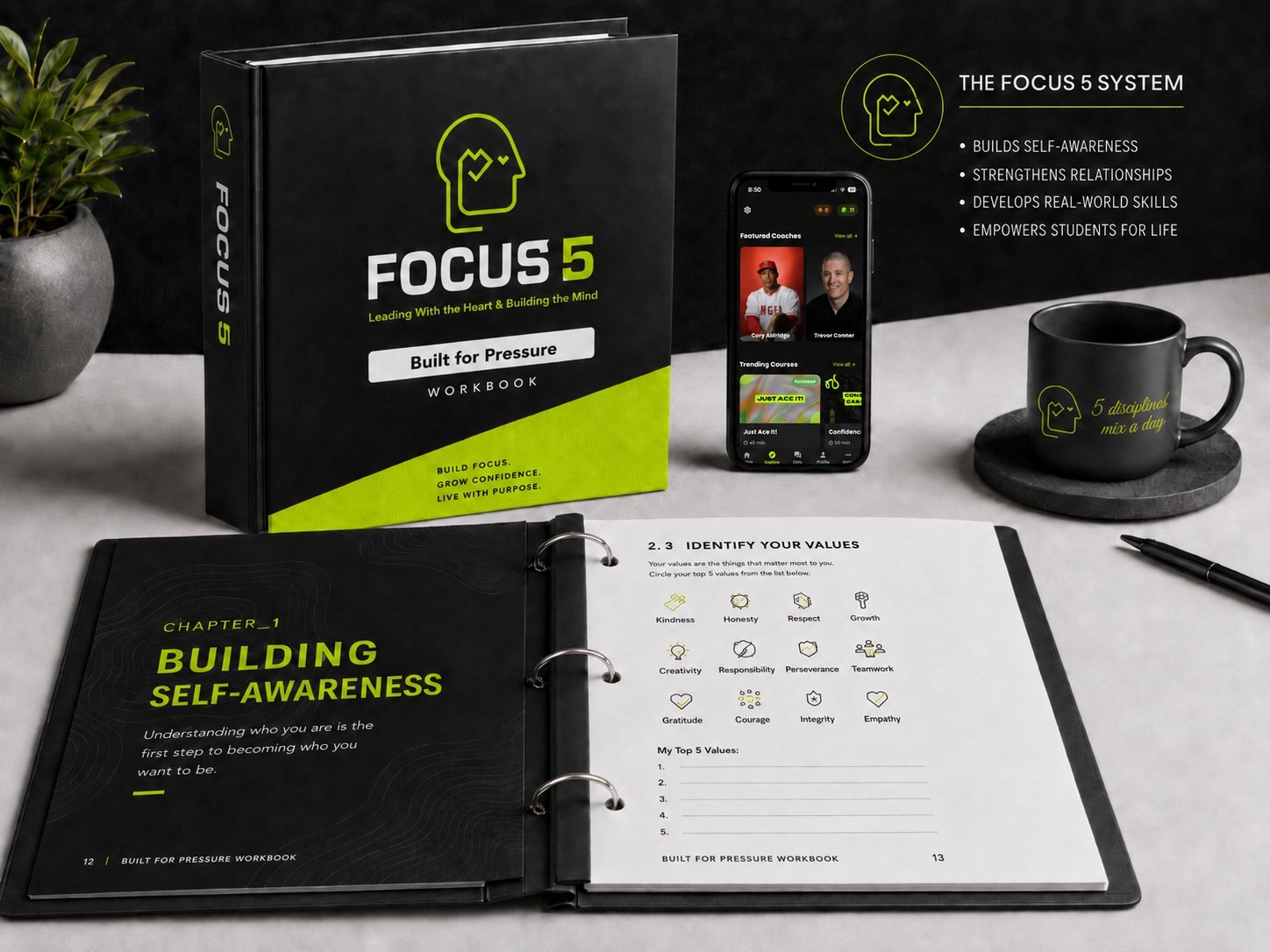
Live Weekly Coaching
Seven sessions to learn mental skills, ask questions, and work through situations from their sport.
Printed Workbook
Worksheets for athletes and companion pages for parents, shipped to your home.
Daily Focus 5 App
Five minutes of daily mental training to practice between live sessions.
Google Classroom + Challenges
Weekly assignments give athletes something to try in practice or competition and reflect on afterward.
Digital Assessments
Check-ins before, during, and after the Academy help athletes track how they describe their confidence, focus, and responses to pressure.
What athletes learn each week
Seven weekly sessions for athletes, followed by a parent workshop in week 8. Each session gives athletes a skill to practice before the next meeting.
Identity & Self-Awareness
"Who am I becoming?"
The Brain Under Pressure
"How does my brain affect my performance?"
Emotional Control
"What can I do when I'm frustrated or nervous?"
Confidence
"How do I build confidence I can rely on?"
Focus & Stress Management
"How do I stay focused and calm under pressure?"
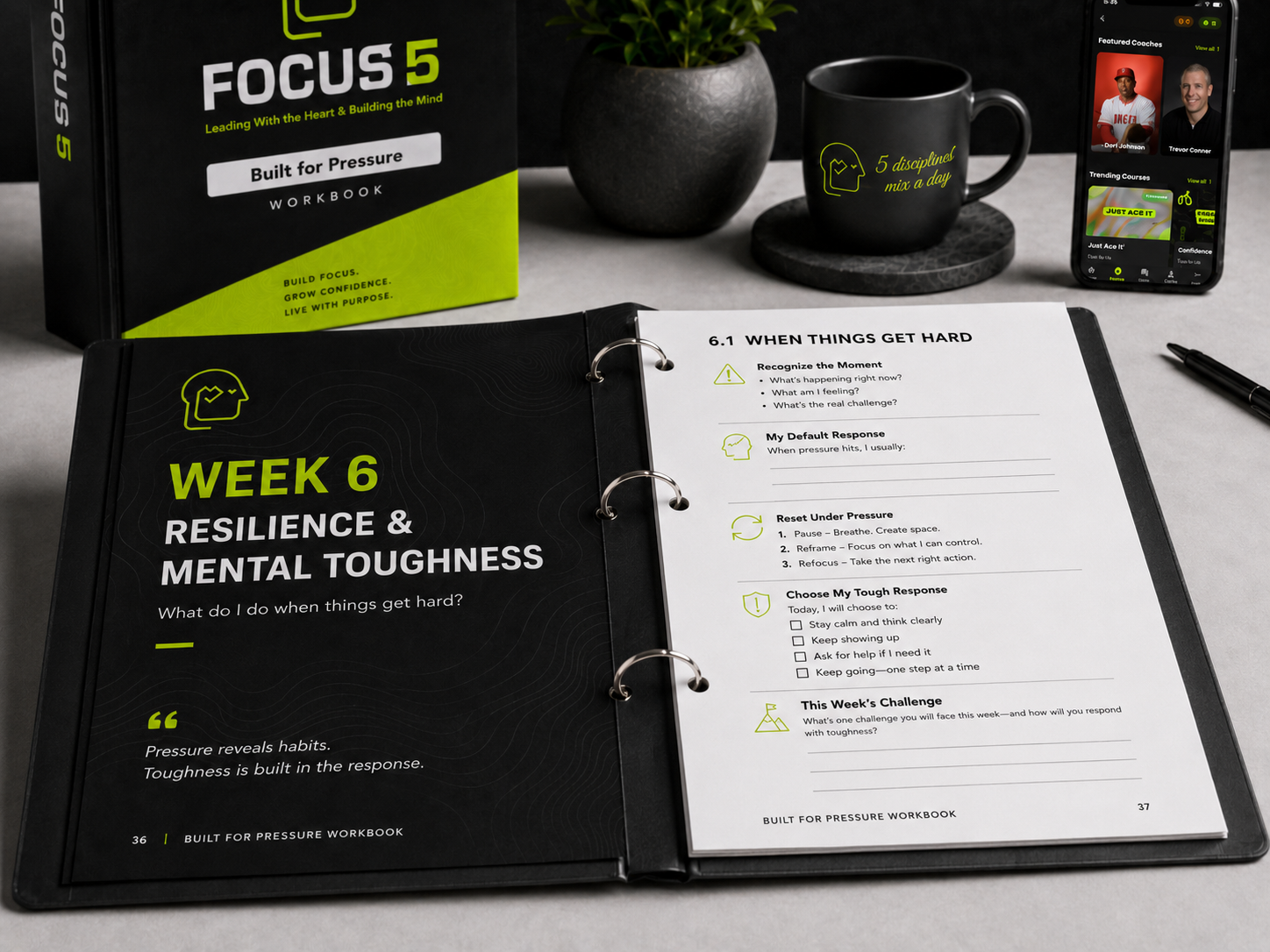
Resilience & Mental Toughness
"What do I do when it gets hard?"
Leadership, Purpose & Vision
"What do I want to work toward, and what will I do next?"
Supporting your athlete under pressure
Practice how to respond when your athlete is upset, talk about a difficult game, and encourage ownership. We'll also cover how parents can support the athlete's 30-day plan after the Academy.
Keep practicing
between sessions.
Each enrolled family receives a printed workbook with approximately 70–80 pages of athlete exercises and parent companion pages. Athletes use it to reflect on their sport, practice each week's skill, and write their 30-day plan. Parents can follow along and use the prompts to start a conversation.
- Athlete worksheets for every chapter
- Parent companion pages in every chapter
- Weekly application challenges
- Tools to use before and after competition
- Reflection pages and a final 30-day growth plan
- Exercises used alongside Focus 5 and Google Classroom
Daily practice and check-ins
Focus 5: 5 Minutes a Day
Athletes use Focus 5 for five minutes or less each day. It gives them a regular place to practice the mental skills covered in live coaching and carry that work into their sport.
Five minutes a day, alongside the weekly coaching.
Track patterns over time
Athletes complete check-ins before, during, and after the Academy. Comparing their responses can help them notice changes in confidence, focus, and how they handle pressure. The results give athletes and coaches something specific to discuss.
Compare responses. Talk through what has changed.
Jessica Marano and Trevor Conner
Jessica leads the weekly coaching. She and Trevor bring experience working with athletes in individual sessions, team settings, and competition.

Jessica Marano
Jessica is an educator and former semi-professional soccer player with more than a decade of coaching experience, including eight years in mental performance. She is completing a Master of Education in School Counseling and has training in trauma and resiliency. In the Academy, she helps young athletes work on confidence, emotions, and the situations they face in their sport each week.

Trevor Conner
Trevor has spent 15 years in sport psychology and has personally trained more than 70 Olympians, 120 professional athletes, and more than 1,200 NCAA Division I athletes. He served as Director of Mental Performance at SPIRE, a U.S. Olympic training site, and worked at IMG Academy as an intern and later a consultant in leadership and mental conditioning. He has also built and directed programs for Navy SPECWAR elements and teams.
15 years working with athletes
Trevor's work spans amateur athletes, collegiate programs, professional sport, and the Olympics. Built for Pressure Academy brings that experience into weekly coaching for athletes ages 12–18, with practice between sessions and support for their parents.
What athletes and parents say
These comments come from athletes and parents who worked with our coaches in individual training and team sessions. They describe that work, rather than results from an Academy cohort.
Coach Jess has been transformative for my daughter in her goals to compete at the highest level, and for us as parents, making sure we support in the best way possible. I've referred many families, and they text me thanks and praise for how Jess supports these athletes. I cannot recommend her enough.
"I no longer buckle under pressure, I thrive in it. I view challenges with a growth mindset and genuinely love my sport again. They taught me the ACE method: the things you can control 100% of the time, Attitude, Concentration, and Effort."
"I've been with Hearts & Minds about two years, and Trevor has helped my mental game develop so much. I play better and more relaxed on court and have a better mindset in practice. I just committed to play college tennis at Embry-Riddle."
"Since joining Hearts & Minds, my coach Jessica Marano has completely changed the way I train and perform. I'm more confident, more energetic, and seeing real results. She's helped me reach levels I didn't think I could."
"I was struggling with focus and frustration on the court. After just a few sessions with Hearts & Minds, I changed my entire mentality about tennis, and about life. The improvement in my game was real."
"Hearts & Minds came and spoke to our high school tennis team about focusing on the controllables. The takeaway stuck: success is a mindset, and it leaves clues."
"They equip athletes with mental tools and show them how to actually apply them. I overcame so many mental hurdles and feel like a confident, well-rounded athlete now."
Questions about joining
Is this therapy?
Is this only for athletes who are struggling?
My athlete is quiet or nervous in groups. Will they be okay?
What if we miss a live session?
How much time does this take?
How will we know it's working?
Why is Focus 5 required?
What happens after the seven weeks?
Ask about Built for Pressure Academy.
Email hello@hmperform.com for current dates, availability, and enrollment details. Tell us your athlete's age, sport, and what you'd like help with.